The science, evidence, and clinical experience behind Gum Builder™

A peer-to-peer overview of the regenerative biology, the FDA record, and the emerging clinical evidence supporting non-surgical gingival regeneration with calcium hydroxylapatite (CaHA / Radiesse+)

the materials

What CaHA is, and the FDA record behind it.

Calcium hydroxylapatite (CaHA) is a bioceramic chemically nearly identical to the mineral component of human bone and teeth — Ca₁₀(PO₄)₆(OH)₂. In Radiesse® and Radiesse+®, CaHA is manufactured as smooth, uniform microspheres suspended in a sodium carboxymethylcellulose (CMC) gel carrier. The gel provides immediate three-dimensional volume; the microspheres remain in tissue as a biological scaffold that triggers the body’s own regenerative response.

Radiesse was first approved by the U.S. FDA in December 2006. Its indications have since been expanded three times — covering hand augmentation, jawline contour improvement, and most recently, in May 2026, the décolleté area. With four cleared indications and nearly two decades of post-market clinical experience, Radiesse is the only FDA-approved bioceramic dermal filler currently on the U.S. market, and the only biostimulator in the United States cleared for use on both face and body.
Regulatory framing for Gum Builder™

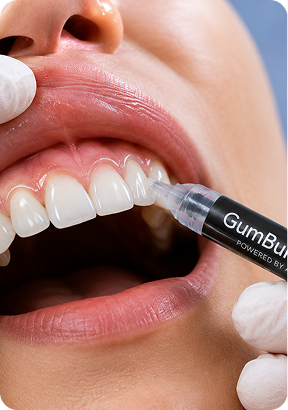
Gum Builder™ uses Radiesse+ — an FDA-cleared injectable — for a dental and periodontal application. Use of CaHA for gingival and interdental papilla regeneration is an off-label clinical application of an FDA-cleared device, performed at the professional discretion of a trained, licensed clinician. This is consistent with how many established dental and medical applications of cleared devices operate, and is communicated transparently to patients during informed consent.

Mechanism

Volume, then regeneration.

CaHA operates through a dual mechanism that distinguishes it fundamentally from purely volumetric HA fillers. This is the single most important scientific point of the page.

Immediate volumization

On injection, the CMC gel carrier delivers visible, day-of-treatment correction. The patient leaves the chair with their result already initiated.

Biostimulation

Over the following weeks and months, the gel carrier is gradually absorbed and replaced by the body. The CaHA microspheres remain in tissue and act as a physical scaffold that activates surrounding fibroblasts, driving neocollagenesis production of new endogenous Type I and Type III collagen — alongside organized elastin fibers and an enriched extracellular matrix. This regenerative process occurs with minimal adaptive immune cell recruitment and without chronic inflammation.

Resorption

The CaHA microspheres themselves are gradually metabolized through normal physiologic calcium pathways and excreted, leaving behind the patient’s own newly regenerated collagen and elastin scaffold.

Tissue Match

Why CaHA suits the gingival environment.

Gingival and papillary connective tissue is highly vascularized and rich in fibroblasts — precisely the cellular environment in which CaHA exerts its biostimulatory effect. Three properties make it well-matched to the demands of papilla regeneration:

Immediate volumization

Because CaHA is chemically nearly identical to the inorganic phase of bone and tooth structure, the body recognizes it as a familiar material rather than a foreign body. There is no animal-derived protein, no skin testing required, and no allergic cross-reactivity profile of clinical concern.

Scaffold behavior in soft tissue

The microsphere matrix supports fibroblast proliferation and collagen deposition within the interdental papilla, addressing not only the volumetric deficit visible to the patient but also the underlying connective tissue architecture lost to recession, papillary atrophy, or surgical and extraction sequelae. The result is reinforcement of tissue structure, not just space-filling.

Sustained correction

Because the regenerated collagen scaffold persists after the carrier and microspheres themselves resorb, CaHA-based gingival treatment is positioned to yield longer-lasting esthetic and functional improvement than volume-only approaches — relevant for patients managing recession, root sensitivity, food impaction, and the esthetic burden of black triangles.

Clinical Evidence

How Gum Builder™ differs from surgical alternatives.

Conventional periodontal solutions to deficient interdental papilla connective tissue
grafting, coronally repositioned flaps, gingivo-papillary unit reconstruction

Surgical Reconstruction

Gum Builder™ (CaHA / Radiesse+)

Procedure time

60–90+ minutes

10–15 minutes

Anesthesia

60–90+ minutes

10–15 minutes

Donor site

Palatal harvest required

None

Sutures

Yes

No

Patient downtime

1–2 weeks of activity restriction

Same-day return to normal activity

Predictability

Variable; biotype- and operator-dependent

High, with appropriate case selection

Repeatability

Limited; surgical morbidity compounds

Re-treatable on a maintenance cadence

Tissue effect

Volume restoration via grafted tissue

Volume + biostimulated regeneration of native collagen

Patient & Provider Experience

What patients feel, and what providers report.

For patients

Overall satisfaction scores are excellent by any healthcare standard. Patients consistently report high comfort during and after treatment, meaningful sensitivity relief, and a positive overall experience. The vast majority indicate they would repeat the treatment and recommend it to friends or family — the metrics that matter most for case acceptance and practice growth.

For providers

Providers report that the treatment is straightforward to explain to patients and that the protocol itself is easy to follow. Study administrative support has been rated highly, and overall provider experience scores are strong.

One honest call-out: ease of delivery the injection technique itself is the area where providers indicate the most room for growth, with some reporting they would benefit from additional hands-on training. This is not a weakness of the treatment. It is the strongest argument for the AAFE Gum Builder course. The protocol is reproducible, the outcomes are predictable,

Tissue Match

Safety profile and longevity.

Across nearly two decades of global clinical use and millions of treatments in approved indications, CaHA has established a robust safety record. The product is non-immunogenic, non-toxic, biocompatible, biodegradable through normal physiologic pathways

Common, transient reactions

Consistent with any transmucosal or transcutaneous injection — bruising, swelling, redness, and tenderness at the injection site, typically resolving within days.

Uncommon to rare reactions

Nodule formation (largely technique-related and avoidable with proper placement), hypersensitivity-type reactions, and infection. As with all injectable fillers, vascular occlusion is a recognized risk if product is inadvertently introduced into a vessel — sound anatomical knowledge, validated injection technique, and on-site emergency protocols are the standard of care at every Gum Builder™ treatment site.

Longevity

In approved facial applications, CaHA correction commonly persists approximately one year or longer, with extended benefit in many patients attributable to the biostimulatory remodeling of native tissue. Duration figures specific to the gingival application are reported in AAFE clinical materials.

Ready to integrate Gum Builder™ into your practice?

Train with the team that built the protocol.

The AAFE Gum Builder course is the only training program developed alongside the clinical study itself. Hands-on technique, case selection, integration into existing workflow.

Scroll to Top